
1Executive summary
The European Union has implemented a rigorous regulatory framework to eliminate the intentional addition of microplastics to consumer products. Commission Regulation (EU) 2023/2055, amending Annex XVII of the REACH Regulation, introduces a prohibition on the sale of “Synthetic Polymer Microparticles” (SPMs). This restriction targets synthetic or chemically modified natural polymers that are water-insoluble and persist in the environment.
For the cosmetics and suncare industry, this necessitates a critical evaluation of inorganic UV filters, as common surface treatments often meet the SPM criteria. The following facts define the current regulatory status:
- Effective date: the general ban on the entry of SPMs into the market became effective on October 16, 2023.
- Rinse-off transition deadline: non-compliant rinse-off cosmetic products must be removed from the market by October 16, 2027.
- Leave-on transition deadline: leave-on cosmetic products, including sunscreens, must comply by October 16, 2029.
- Classification of treated zinc oxide: zinc oxide (ZnO) surface-treated with Triethoxycaprylyl Silane (TECS), like all other pigments treated with TECS, will be classified as an SPM under current REACH definitions.
This briefing outlines the technical and legal basis for these classifications and provides a roadmap for industry compliance.
2Regulatory framework: REACH Regulation (EU) 2023/2055
The restriction on SPMs is a cornerstone of the European Commission’s broader “Plastics Strategy” (January 2018) and the “European Green Deal” (December 2019). This strategic evolution continued with the “Circular Economy Action Plan” (March 2020) and the “Zero Pollution Action Plan” (May 2021), which established a mandatory target to reduce microplastic release into the environment by 30% by the year 2030. Under the legal authority of Article 68(1) of REACH, the Commission prohibits the placing on the market of SPMs as substances on their own or in mixtures where the concentration is equal to or greater than 0.01% by weight.
The regulation follows a phased implementation schedule to allow for industry reformulation:
- Microbeadse.g., exfoliants, polishes
- Rinse-off cosmetics
- Leave-on cosmeticse.g., sunscreens
Market entry for cosmetic products is now contingent upon meeting these deadlines, as the EU prioritizes the reduction of biopersistent particulate matter in aquatic and terrestrial ecosystems.
3Technical definition of Synthetic Polymer Microparticles (SPM)
The classification of a material as an SPM is based on the following cumulative criteria:
- Solid polymer: the material must consist of solid polymers. Liquid and gaseous polymers are currently excluded.
- Physical form: the definition applies to the polymer particle as such, or particles where the polymer is ≥1% by weight or forms a continuous surface coating (in which case no lower limit applies).
- Dimensions: particles where all dimensions are ≤5mm, or fiber-like particles where the length is ≤15mm and the length-to-diameter ratio is >3.
Regulatory exceptions (out of scope)
A substance is exempt only if it meets one of the following “Out of Scope” criteria:
- 1
Natural polymers
Resulting from a natural polymerization process and not chemically modified.
- 2
Biodegradable
Demonstrated via specific regulatory testing methods.
- 3
Water-soluble
Solubility >2g/L (e.g., certain celluloses or PVA).
- 4
Inorganic polymers
Specifically defined as polymers without carbon atoms in their structure.
4Cosmetics Europe and EFfCI guidance on the microplastic restriction
In order to facilitate the interpretation of microplastics (or SPM), Cosmetics Europe and EFfCI have published a guidance document [1] that is based on an assessment of five rulebases. These are:
- 1
Does the ingredient contain a polymer?
The first key element is whether a polymer is present. While multiple definitions exist, a clear consensus in the industry is: “A substance … containing at least three monomer units which are covalently bound to at least one other monomer unit …” [2]
- 2
Is the polymer a solid?
Only solid polymers are in scope of the SPM regulations, and it needs to be determined if the polymer is in a solid state and not in a gaseous or liquid state.
- 3
Polymer in or out of scope
Natural polymers and those that are water-soluble, biodegradable or without carbon atoms are outside the scope of the SPM regulations. The key determination is whether a polymer is persistent or not.
- 4
Particle size
Particles that have a dimension ≤5mm are considered SPMs in the regulation. Particles with at least one dimension >5mm are defined out of scope.
- 5
Amount of polymer present and surface coating
If at least 1% by weight of a particle is composed of a polymer that is in scope of the SPM regulation, the whole particle is considered an SPM (if it meets the size criteria). Any particle meeting the size criteria that has a continuous surface coating that is a polymer in scope of the regulation is considered an SPM, irrespective of the weight percentage present.
5Implications of the decision tree for TECS-coated ZnO
When applying the decision tree rulebases to TECS-coated zinc oxide, or other pigments for that matter, the following assessment is made:
- 1
Polymer presence
A polymer contains at least three monomer units covalently bound. As detailed in Indumathy et al. (Polymers 2023), TECS molecules undergo hydrolysis, releasing ethanol molecules, followed by condensation. The reactive nature of hydrolyzed Si-O groups causes rapid cross-linking, resulting in a hyperbranched polymeric structure where n>3. [2]
- 2
Physical state
Determining the state of a thin coating is complex; however, Transmission Electron Microscopy (TEM) imaging performed under vacuum confirms the TECS network remains intact and clearly visible. This visibility under vacuum serves as the definitive proof that the polymer exists in a solid state on the ZnO surface. [3]
- 3
Persistence
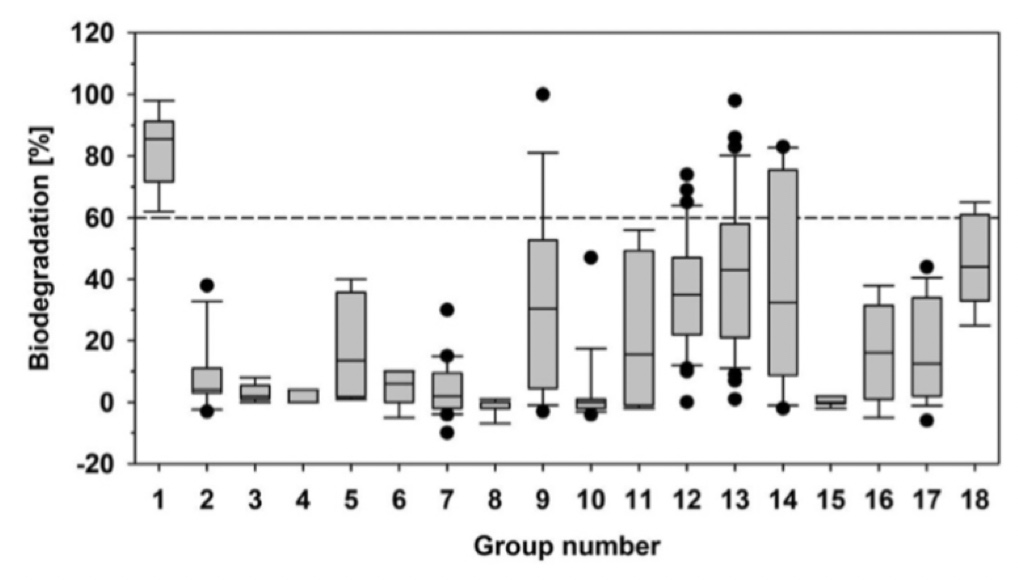
TECS is a synthetic organosilicon compound containing carbon. Grabitz et al. (2021) confirmed that cyclic, linear, and branched siloxanes are non-biodegradable. [4]
- 4
Dimensions
Primary particle sizes for cosmetic ZnO range from tens of nanometers to several microns, well below the 5mm threshold. [5]
- 5
Concentration and coating
The technical intent of TECS is to create a continuous hydrophobic surface treatment onto ZnO. In fact, it is the whole purpose to do so and render the surface hydrophobic and prevent interaction of ZnO with, for example, water phase.
6Compliance roadmap and global regulatory alignment
Immediate reformulation is required to meet the 2027/2029 deadlines. Furthermore, manufacturers must account for other chemical restrictions and global shifts.
Global regulatory alignment
- United States: California and other states are advancing state-level microplastic bans, with definitions expected to align with EU interpretations and as such, the above-mentioned assessments and conclusions will impact SPM in the US as well.
7References
- Cosmetics Europe and EFfCI. Guidance on Annex XVII Restriction of SPM, July 2024. cosmeticseurope.eu
- Indumathy B, Sathiyanathan P, Prasad G, Reza MS, Prabu AA, Kim H. A Comprehensive Review on Processing, Development and Applications of Organofunctional Silanes and Silane-Based Hyperbranched Polymers. Polymers 2023, 15, 2517. doi.org/10.3390/polym15112517
- Purcar V, Şomoghi R, Niţu SG, Nicolae C-A, Alexandrescu E, Gîfu IC, Gabor AR, Stroescu H, Ianchiş R, Căprărescu S, et al. The Effect of Different Coupling Agents on Nano-ZnO Materials Obtained via the Sol–Gel Process. Nanomaterials 2017, 7, 439. doi.org/10.3390/nano7120439
- Grabitz E, Olsson O, Kümmerer K. Towards the design of organosilicon compounds for environmental degradation by using structure biodegradability relationships. Chemosphere 2021 Sep; 279: 130442. doi: 10.1016/j.chemosphere.2021.130442. PMID: 33887595.
- European Commission, Scientific Committee on Consumer Safety (SCCS), document sccs_o_103. ec.europa.eu
Questions about reformulating?
We are happy to send you a copy of this technical brief, or to talk through your formulation.