
1Introduction
The sunscreen market is seeing distinct trends in recent years, including the growing importance of mineral-based sunscreens and the trend for higher SPF numbers. This trend is driven by consumers becoming more conscious about their sunscreen and daily wear products and the desire to protect skin from harmful UV radiation.
Mineral sunscreens rely increasingly on zinc oxide as main filter – it is a safe ingredient to use and provides balanced UVA and UVB protection and allows to meet global UVA requirements.
The use of zinc oxide is capped at 25% maximum in most parts of the world, and this limits the SPF value to be attained for ZnO-only systems and SPF value of 35-40. In order to get to higher SPF values like 50 or 50+, ZnO needs to be combined with other active and/or supporting ingredients, such as UV or SPF boosters.
This document provides five different strategies to boost the performance of ZnO based sunscreens, which are equally applicable to chemical-filter based sunscreens as well. Each type of booster works according to a different mechanism. Each of them has their pros and cons and some even face ethical concerns.
2Summary
In order to boost the performance of sunscreens, several strategies are available to formulators to effectively increase the SPF and UVA. They can be categorized into five distinct groups, with new ingredients coming to the market every year. Choosing the best strategy is based on brand principles, formulation choices, and ethical considerations in some cases:
- iUse of other (UV-)active ingredients
- iiUse of anti-inflammatory ingredients
- iiiIncreasing film formation
- ivUse of path-length extenders
- vUse of electron-trap booster
2.1Comparison table
| Strategy | Mechanism | Example ingredients | Validated by | Key consideration |
|---|---|---|---|---|
| Other active ingredients | Non-approved ingredients with distinct intrinsic UV absorption, added alongside approved filters | Butyloctyl salicylate | In-vitro (visible in product absorption spectrum) | Not a recognized/approved UV filter in most markets; regulatory scrutiny increasing [2] |
| Anti-inflammatory ingredients | Reduces erythema/redness response, which raises the measured in-vivo SPF without boosting actual UV absorption | Various anti-inflammatory actives | In-vivo only (no in-vitro effect) | Unclear whether reduced redness reflects reduced UV-induced DNA damage, or simply masks it |
| Increasing film formation | Promotes an even, continuous film so UV filters are uniformly distributed on skin | Film-forming emollients; synthetic, natural-origin, and silicone elastomer polymers | In-vivo and in-vitro | Choice of emollient affects play-time and film integrity; polymers often also improve water resistance [3,4] |
| Scattering / path-length extenders | Non-absorbing particles with a specific refractive index/size extend the UV path length within the film, increasing probability of absorption by a filter | Hollow plastic spheres, silica particles, microcrystalline cellulose | In-vitro and in-vivo | Works across nearly all formulation types, since most UV protection, even from physical filters, is absorption-based [5,6] |
| Electron-trap boosters | Accelerates the return of an excited UV-filter electron to ground state, increasing the rate at which the filter can absorb further UV photons | Quenching agents (e.g., Octocrylene's triplet-state quenching of avobenzone) | In-vitro (Helio2, ISO 23698) distinguishes this from filter-additive effects | Mechanistically distinct from simple filter-filter addition; requires spectrum-wide in-vitro testing to confirm [7,8] |
3Different boosting mechanisms and strategies
3.1Other active ingredients
A strategy that has been applied often to boost performance of sunscreens is to add ingredients that do have a distinct UV absorption on their own. Even though they are not technically a ‘booster’ by this definition, these types of ingredients, for example butyloctyl salicylate, are not recognized or approved UV filters [2] and therefore considered a ‘booster’ in general. Since these ingredients have a distinct absorption profile, the presence is clearly visible in the final sunscreen product’s absorption spectrum. The use of this type of ingredient is common in some markets but is getting increasingly scrutinized.
3.2Use of anti-inflammatory ingredients
The SPF performance of a sunscreen is determined in-vivo by evaluating how much longer it takes for protected skin to show signs of erythema upon UV exposure versus unprotected skin.
Some booster ingredients on the market play on reducing redness by acting as anti-inflammatory agent. By reducing redness of skin, higher SPF numbers are reached.
Such ingredients thus have no intrinsic UV protection or blocking capabilities and their effectiveness is only observed in in-vivo SPF tests, not in-vitro as they do not boost the UV performance of a sunscreen itself.
This mode of action is being criticized as it is not clear if a reduction of erythema/redness also means a reduction of UV-induced DNA damage or that it is simply masking it. It is therefore a strategy that needs to be considered properly before being used.
3.3Increasing film formation
The principle of a sunscreen is to form a continuous film on the skin with UV filters evenly dispersed in them. If the sunscreen film is uneven, irregular, or does not form a uniform film, it leaves patches of skin less protected or not protected at all.
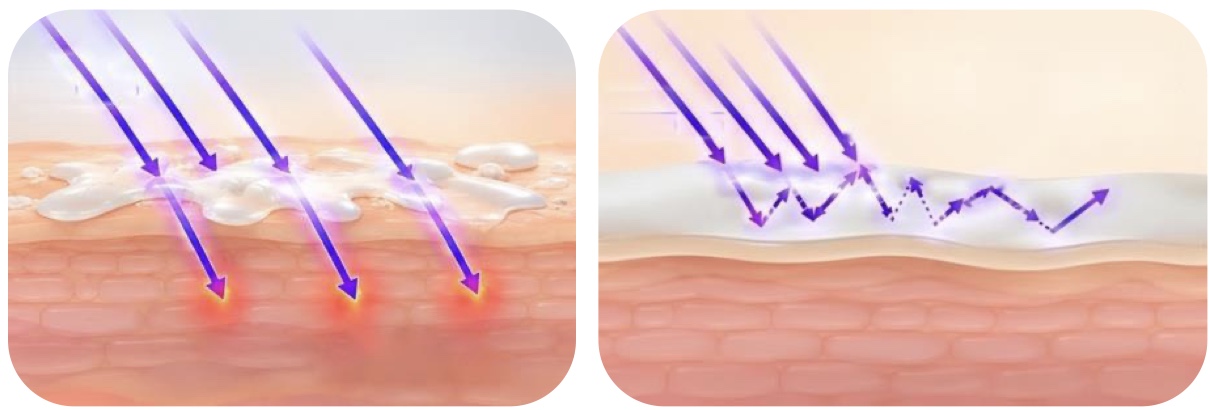
To increase film formation, several tools can be used, including:
3.3.1Emollients
The choice of emollients plays a vital role in final sunscreen film integrity [3,4]. Some emollients provide longer play-time, emollience, and have inherently better film forming capabilities. Other more volatile emollients may give a softer and lighter skin feel but may not allow for enough playtime to form a regular film or have little film forming capabilities on their own. The choice of emollients is thus a key parameter in sunscreen design.
3.3.2Polymers
Film forming polymers are used in a wide variety of sunscreen products. Their main function is, as the name implies, to help sunscreen film formation, but they are often used to increase water-resistance too; two parameters that go hand-in-hand. Nowadays there are many types of film forming polymers to choose from, from synthetic to natural-origin polymers and silicone elastomers.
3.4Scattering and path-length extenders
The principle of a sunscreen is for UV radiation to travel through a sunscreen film and the energy of those rays to be captured by a UV filter or scattered out of the film again (reflecting).
Path-length extenders are boosters that often are non-absorbing particles with a specific refractive index and size and they effectively let the UV radiation travel through a sunscreen film longer, thereby increasing the probability of the photons being absorbed by a UV filter.
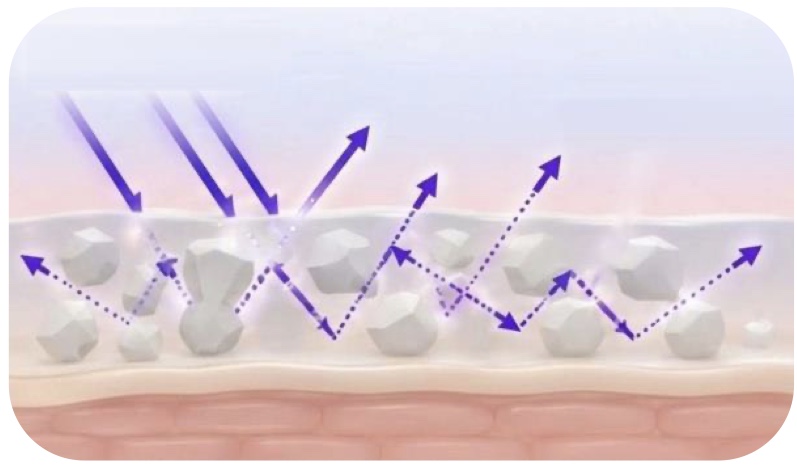
Examples of such scattering agents/path-length extenders are hollow plastic spheres, silica particles, or microcrystalline cellulose. [5,6]
Since the majority of UV protection provided by filters, even physical ones, is absorption, this technique works for almost all kinds of sunscreen formulations [9].
3.5Electron-trap boosters
The principle of a filter like zinc oxide to absorb UV radiation is by absorbing the radiation energy. When doing so, electrons in the zinc oxide molecule will reach an excited state. The absorbed energy is then released (in the form of IR for example) and once the electron reaches its ground state it is available to absorb more UV radiation energy.
The mechanism of an electron-trap booster is that when in the proximity of a UV filter, the booster interacts with the excited state of a UV filter to accelerate its return to the ground state, increasing the rate at which the filter can absorb additional UV photons.
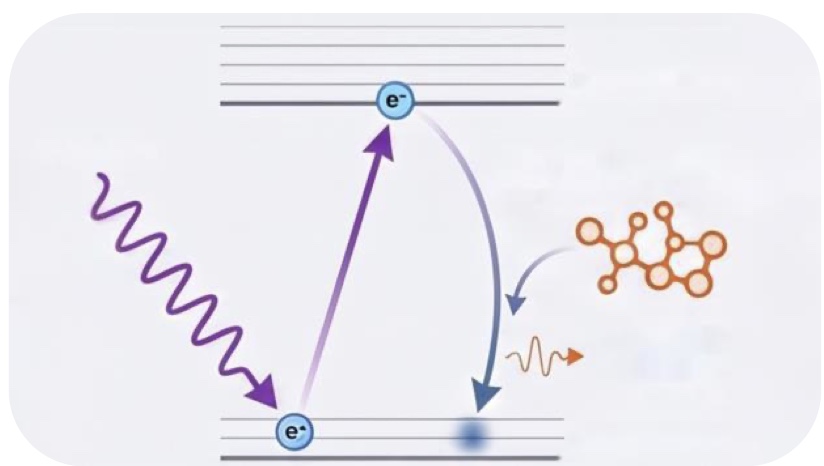
In other words, the natural process of absorbing and releasing energy is sped up, thereby increasing the intrinsic capacity of the UV filter, thus boosting its performance.
The electron-trap or quenching mechanism is also observed in the classical example of Octocrylene’s triplet-state quenching of avobenzone in the lipid phase. [7,8]
3.6Other considerations
Besides the above-mentioned available strategies to boost the performance of sunscreens, the basis of good sunscreen formulating practices should always be observed. This includes ensuring perfect formulation stability over time (emulsion, separation, etc.) and in the case of physical filters, high-quality dispersion of the ZnO and TiO2 filter needs to be ensured over the whole stability-period.
Third, the test methodology should match the mechanism. In-vivo SPF (ISO 24444) remains the regulatory reference. [1] In-vitro methods such as Helio2 or ISO 23698 are appropriate for screening, dose–response work, and UVA-PF, and they capture the spectrum-wide signature that distinguishes electron trap boosters from filter-additive effects.
4References
- Commission Recommendation 2006/647/EC of 22 September 2006 on the efficacy of sunscreen products and the claims made relating thereto. Off J Eur Union 2006; L 265: 39–43.
- Regulation (EC) No 1223/2009 of the European Parliament and of the Council of 30 November 2009 on cosmetic products, Annex VI (List of UV filters allowed).
- Herzog B, Sohn M, Osterwalder U. How a calculated model of sunscreen film geometry can explain in vitro and in vivo SPF variation. Photochem Photobiol Sci 2010; 9: 537–542.
- Sohn M, Herzog B, Osterwalder U. Film thickness frequency distribution of different vehicles determines sunscreen efficacy. J Biomed Opt 2014; 19 (11): 115005.
- Bressel L, Reich O, Herzog B. Monte-Carlo simulations of light transport in dense materials: dependent scattering and influence on sunscreen formulations. Proc SPIE 2019; 11074: 110741P.
- Herzog B, Wang S. Monte Carlo simulations of light transport in sunscreen formulations. Photochem Photobiol Sci 2024; 23: 1437–1454.
- Damiani E, Astolfi P, Cionna L, Ippoliti F, Greci L. Filter–filter interactions: photostabilization, triplet quenching and reactivity with singlet oxygen. Photochem Photobiol Sci 2010; 9: 552–558.
- Bonda CA, Lott D. Sunscreen Photostability. In: Wang SQ, Lim HW (eds), Principles and Practice of Photoprotection. Cham: Adis, 2016.
- Cole C, Shyr T, Ou-Yang H. Metal oxide sunscreens protect skin by absorption, not by reflection or scattering. Photodermatol Photoimmunol Photomed 2016; 32: 5–10.
Want the full guide?
We are happy to send you a copy of this guide.